Licorice ferns, Polypodium glycyrrhiza, on old roots dangling down a dripping side hill.
With mosses and powdery lichens.
We see this fern growing mostly on mossy tree trunks, usually big-leaf maples, far above our heads, but the rhizomes can also spread over rocks. It likes vertical, mossy surfaces. Here, it's down at eye level, on a side hill cut into to make space for a narrow trail.
~~~~~~~~~~~~~~
Esto es helecho de regaliz, Polypodium glycyrrhiza, creciendo en unas raices viejas colgadas sobre un corte vertical en el terreno, tal corte hecho para hacer espacio para un sendero angosto. Comunmente vemos este helecho muy por encima de nuestras cabezas, creciendo en los troncos de árboles, principalmente de acer de hojas grandes, Acer macrophyllum, pero también sus rizomas pueden extenderse sobre rocas y tierra. Prefiere superficies verticales cubiertos de musgos.
"Looks like turkey tail." I've had to say this often, seeing these mushrooms. "Probably turkey tail."
Turkey tail colours are variable, depending on their age, and they are often colonized by green algae. And there are other look-alike species, some also common in this area. So, is it turkey tail, or a copy-cat?
I think this is turkey tail, Trametes versicolor.
Section of branch loaded with turkey tails.
Turkey tails are polypores; turn one over and with a hand lens you can see the tiny pores in the white flesh. On top, they're hairy, multi-coloured, with semi-circular zones, up to about 10 cm. across. They grow in clusters (after all, they're just the fruiting bodies of the fungus; the rest of it is the mycelium inside the wood. Like the apples on an apple tree, fruiting apple bodies.)
So far, so good. But there's always the doubt; am I missing something? Maybe it's a Hairy Stereum? Or something else?
Looking at hundreds of photos and species descriptions of turkey tails didn't help. But just tonight, I discovered Michael Kuo's (The Mushroom Expert) "Totally True Turkey Tail Test".
1) Is the pore surface a real pore surface? Like, can you see actual pores?
Yes: Continue.
No: See Stereum ostrea and other crust fungi.
2) Squint real hard. Would you say there are about 1–3 pores per millimeter (which would make them fairly easy to see), or about 3–8 pores per millimeter (which would make them very tiny)?
3–8 per mm: Continue.
1–3 per mm: See several other species of Trametes.
3) Is the cap conspicuously fuzzy, velvety, or finely hairy (use a magnifying glass or rub it with your thumb)?
Yes: Continue.
No: See several other species of Trametes.
4) Is the fresh cap whitish to grayish?
Yes: See Trametes hirsuta.
No: Continue.
5) Does the cap lack starkly contrasting color zones (are the zones merely textural, or do they represent subtle shades of the same color)?
Yes: See Trametes pubescens.
No: Continue.
6) Is the fresh mushroom rigid and hard, or thin and flexible?
Rigid and hard: See Trametes ochracea.
Thin and flexible: Totally True Turkey Tail.
So: for the samples above, my score is:
1 & 2; I didn't look. Next time.
3.Yes, obviously hairy.
4. No, orange, brown, and bright white.
5. No. Lots of contrast here.
6. Thin and flexible.
So, I think I can say these are turkey tails, but I can't claim the "Totally True" score without having looked at the pores. Next time.
"Parece ser cola de pavo." Así lo he dicho muchas veces, mirando estos hongos. "Probablemente."
Los hongos llamados cola de pavo pueden tener una variedad de colores, según su edad y además si se han cubiertos de algas verdes. Y hay varias especies muy parecidas, algunas de las cuales se encuentran comunmente por estos rumbos. Así que se hace la pregunta —¿Es cola de pavo? ¿U otro hongo parecido?
Probablemente Cola de Pavo, Trametes versicolor.
Una sección de rama llena de hongos.
Los hongos Cola de Pavo son políporos; mirando la superficie inferior con una lente de mano, puedes ver los poros en la carne blanca. La superficie superior es peluda, de muchos colores haciendo zonas semicirculares, y miden hasta unos 10 cm de diámetro. Se producen en grupos (puesto que son nada más los cuerpos fructíferos del hongo entero, que incluye el micelio dentro de la madera. Algo así como las manzanas que crecen en grupos sobre el manzano.)
Hasta aquí vamos bien. Pero siempre queda la duda. ¿Se me habrá escapado algún detalle? ¿Tal vez sea un Stereum sp.? ¿Alguna otra especie?
Mirar cientos de fotos y descripciones de especie no ayudó. Pero esta noche he encontrado en el sitio web de Michael Kuo, el llamado "Experto sobre Hongos", su serie de preguntas, "Prueba Absolutamente Verídica de los hongos Cola de Pavo." (En inglés cinco palabras empezando con "T".)
1. ¿Tiene poros? ¿Los puedes ver?
Si: Sigue adelante.
No: Busca Stereum ostrea y otros hongos.
2. Mira muy de cerca. ¿Hay de 1 a 3 poros por milímetro, lo que los hace fácil de ver, o 3 a 8 por milímetro, lo que los hace muy pequeñitos?
3 a 8: Sigue adelante.
1 a 3: Busca varias otras especies de Trametes.
3. ¿Es visiblemente velludo o terciopelado? (Usa tu lente, o frótalo con el dedo.)
Si: Sigue adelante.
No: Busca varias otras especies de Trametes.
4: ¿Es el hongo fresco grisáceo o blancuzco?
Si: Busca Trametes hirsuta.
No: Sigue adelante.
5: ¿Le faltan zonas de color con contraste marcado? (O sea, ¿las zonas se diferencian solo por la textura, o representan diferencias sutiles del mismo color?
Si: Busca Trametes pubescens.
No: Sigue adelante.
6: ¿Es el hongo duro y tieso, o delgado y flexible?
Duro y tieso: Busca Trametes ochracea.
Delgado y flexible: Cola de Pavo Absolutamente Verídico.
Bueno, para los hongos en las fotos, mis resultados son:
1 y 2: No miré los poros. La próxima vez, lo haré.
3: Si: muy velludo.
4: No; anaranjado, café, y blanco claro.
5: Zonas de color marcadas.
6: Delgado y flexible.
Pues, puedo decir que creo que estos son hongos Cola de Pavo, pero no puedo afirmar una identificación "Absolutamente Verídica" sin haber mirado los poros. Será para la próxima vez.
Sometimes I'm in too much of a hurry. I kept up a good pace following a trail through the woods beside the lake. Dry woods, young (second-growth? Third?) Douglas-fir trees; the understory was mostly salal, Oregon-grape, and huckleberries, with bracken ferns just uncoiling their early fronds. I saw a trillium. One, very small still. Nothing more.
Coming back, slower now, coddling my gimpy knee, I saw a second trillium and stopped to look at it. And then there was another. And another. Somehow, with each step I took, if I then just stood still for a minute, more showed up. And there were tiny yellow violets.
Down on the coast, spring came earlier. Here, in this long valley surrounded by high mountains, it's just getting started. There were tiny yellow flower buds on the Oregon-grapes; back home, 30 km. as the crow flies, they were in full bloom three weeks ago.
All these trilliums were small and white.
Yellow violet, probably Viola sempervivens. With duff, Oregon-grape leaves.
I should have slowed down even more. I missed the stained Oregon-grape leaves until I saw the photos. These would be last year's leaves, dried and now infested with either a fungus or lichen.
Photo cropped to show the pattern on the dried leaf.
Later, back at the car, I sat for a while on a rock, just watching the forest. A white butterfly arrived and fluttered around a huckleberry bush on the far side of the clearing. I took a photo, even though the butterfly never stood still, and besides, it was too far away. I was surprised later to see, looking closely, that the butterfly's antennae showed up in the photo, although the wings were blurry since they never stopped moving.
Huckleberry bush with new leaves, and butterfly.
~~~~~~~~~~~~~
Vale la pena ir despacio. A veces, se me olvida. Siguiendo el sendero en el bosque al lado del lago el otro dia, mantuve un buen paso, como si se me escapara el tiempo. Era un bosque de abetos de Douglas, árboles juveniles, tal vez después de la tercera tala. El sotobosque se compone de salal (Gaultheria shallon), uva de Oregón (Mahonia nervosa), y huckleberry (Vaccinium parvifolium), y los helechos águila (Pteridium aquilinum) que apenas empezaban a abrir sus frondas. Vi un trilio. Uno, nada más.
Regresando, caminando ya más lentamente, consintiendo mi rodilla adolorida, vi otro trilio y me detuve para mirarlo; fue entonces que vi otro. Y otro. Resultó que con cada paso que daba, si me paraba allí, descubría más. Y había violetas amarillas muy pequeñas, también.
En la costa, la primavera llega más temprano. Aquí, en este largo valle entre montañas altas, apenas empieza. En las uvas de Oregón, había botoncitos amarillos miniaturos, todavía sin abrirse; en casa, a unos 30 km. de distancia a vuelo de pájaro, hace tres semanas las flores ya estaban completamente abiertas.
Todos los trilios eran pequeños y blancos. Más adelante, se vuelven color de rosa.
Violeta amarilla, probablemente Viola sempervivens. Con hojas muertas de uva de Oregón.
Mejor me hubiera detenido aun más. No vi estas hojas de uva de Oregón hasta que las miré en las fotos en casa. Son las hojas del año pasado, ahora colonizados por un hongo o tal vez un líquen.
Llegando al estacionamiento, me senté sobre una roca, descansando y mirando el bosque. Apareció una mariposa blanca y revoloteaba alrededor de un arbusto de huckleberry. No sé porque le saqué una foto; estaba demasiado lejos y además, nunca se detenía. (Pero tenía la cámara en la mano; ya es casi un reflejo habitual.) Me sorprendió, en casa, descubrir que en la foto se pueden ver tenuemente hasta las antenas de la mariposa.
View from the shore of Upper Campbell Lake, mid-island, 50°N, -125°W, filling a long valley 221 metres above sea level, mid-April, 2024. The water is low, with plants that I usually see growing with their roots in water, now sprouting through dry mud. On land, the moss is crunchy dry, crackling underfoot. But new, yellow-green leaves on the shoreline trees promise summer shade.
As of February 1st, the provincial snowpack remains very low, averaging 61% of normal (39% below normal) across British Columbia. ... Low snowpack and seasonal runoff forecasts combined with warm seasonal weather forecasts and lingering impacts from previous drought are creating significantly elevated drought hazards for this upcoming spring and summer.
Doesn't look good.
~~~~~~~~~~~~
Esta es la vista desde la orilla del lago Upper Campbell, situado a media isla, 50°N, -125°W, llenando un valle a una altura de 221 metros sobre el nivel del mar, a mediados de abril de 2024. En la orilla, plantas que normalmente encuentro con las raices en el agua, ahora brotan en lodo seco. En el bosque, el musgo está seco, tostado, crocante. Pero las hojas nuevas, verde/amarillos, prometen sombra para el verano.
A la fecha del primero de febrero, la nieve acumulada de la provincia sigue muy baja, con un promedio 61 porciento del nivel normal (39% bajo el normal) en toda la provincia de CB. ... Pronósticos de niveles bajas de nieve acumulada y escorrontía estacional combinados con pronósticos de temperaturas de temporada elevadas, además de los impactos sostenidos de sequías anteriores crean peligros elevados de sequía para la primavera y verano.
I walked yesterday on the shore of Upper Campbell Lake; a warm, sunny day, too bright, and I wandered down faint trails in the shade under the evergreens. There, a pair of Steller's jays found me and then followed me out onto the road, back under the trees, making comments ("What are you doing? Get out of here!") when I stopped to look at trilliums, until I returned to the campsite where I had parked.
Mostly, they stayed in deep shade, far above me, but I managed to get a few photos.
Cyanocitta stelleri
"It raises or lowers its crest to reflect its relative state of agitation," says the guidebook, Birds of Coastal BC. I gather that they weren't happy with me.
The tail feathers are blue on top, charcoal grey underneath. Adults have bars on the wings.
Keeping a close eye on me.
The Steller's jays nest in April or May; once the 2 to 6 eggs are ready, the female broods them for 16 days, then the pair keeps busy feeding them for another couple of weeks. This couple were out together, with nothing to do but follow me; she must not have a full nest yet.
~~~~~~~~~~~~~
Caminé ayer al lado del lago Upper Campbell. Un dia brillante; tuve que abandonar mi chaqueta por el calor. Opté por vagar en el bosquecito, en sombra. Una pareja de arrendajos de Steller me encontró allí y me siguieron, haciendo comentarios —¿Qué haces aquí? ¡Ya lárgate! — cuando me detenía para mirar las flores, hasta que por fin regresé a donde había estacionado el coche.
Arrendajo de Steller, Cyanocitta stelleri.
El adulto tiene barras en las alas.
Vigilante.
—Levanta o baja la cresta para reflejar su estado de intranquilidad — dice el libro guía, Birds of Coastal BC. Parece que esta pareja no estaba conforme con mi visita.
Los arrendajos de Steller anidan en abril o mayo. Una vez puestos los 2 a 6 huevos, la hembra los incuba por 16 dias, después ambos se ocupan en traer comida para los polluelos por otras dos semanas. Puesto que esta pareja estaban juntos, sin preocupación aparte de vigilar el sitio, creo que todavía no tendrían listo el nido.
10 days. I've been mostly shut in, sleeping or wishing I were sleeping, promising myself to post "tomorrow", for 10 days. I'm awake now, I think.
Outside, the winter's bare branches are clothed in a pale green froth, pink and white blossoms blow in the wind, the sky and sea are blue, blue, blue. At my door, the spring flowers are almost done, and summer's offerings are leafing out. It's time I got my old bones moving. Weeding and planting to do, salmonberry flowers and pink trilliums to visit along the forest trails.
These photos are from 10 days ago.
Bleeding hearts in deep shade.
Heather in full sun.
Pink hyacinths.
Peonies rising from the remains of last year's stalks.
Going out now to see what the day offers. I'll be back tomorrow. Promise!
~~~~~~~~~~~
10 dias. Por los últimos 10 dias, he estado encerrada, dormida o queriendo estar dormida, prometiéndome que "mañana" regreso al blog. Pues, ahora ya me desperté.
Fuera de mis puertas, las ramas desnudas del invierno se han cubierto con una gaza delicada, de un verde clarísimo; flores blancas y color de rosa flotan en el viento; el cielo y el mar se han pintado de azul. Las flores del principio de primavera se empiezan a marchitar y las plantas que producirán los colores de verano están cubiertas de hojas nuevas. Hora es que yo ponga mis huesos viejos en marcha; me espera trabajo en el jardín, y en el bosque las flores de salmonberry y del trilio color de rosa se ven a lo largo de los senderos.
Estas fotos las saqué hace 10 dias.
Corazón sangrante, en sombra intensa.
Brezo, en pleno sol.
Jacintos color de rosa.
Peonías, brotando desde los restos de los tallos muertos del año pasado.
Ahora salgo a ver qué más me ofrece este dia. Regreso mañana, lo prometo.
The day was cloudy but warm, around 10°C. I was heading out to do a bit of weeding and edge trimming. Didn't get far. A deer was browsing on the edge of the lawn next door. She stopped to look at me for a long while, not alarmed, just as if she was memorizing my face; "I'll know you next time." And she waited while I went for the camera and took a dozen photos, then went back, calmly, to doing her own edge trimming.
"Are you the one who grows those delicious hostas?"
Posed against a neighbour's truck. With cherry blossoms.
And I left her to graze in peace. The weeding can wait.
~~~~~~~~~~~
Un bonito dia de primavera; no llovía, no hacía frio, aunque el cielo permanecía nublado. Un buen dia para trabajar en el jardín, y salí con la intención de arrancar hierbas malas y recortar los bordes. Y al abrir la puerta, vi la vendadita, pastando en el césped del vecino. Se detuvo para mirarme, sin temor, más bien como si memorizara mi cara: —Te conoceré a la próxima vez que nos encontramos. ¿Eres la que cultivas esas hostas tan deliciosas, no? — Esperó a que fuera por la cámara y se mantuvo quieta mientras saqué una docena de fotos, luego volvió a comer tranquilamente.
La dejé en paz. El trabajo jardinero puede esperar.
Sparrows are omnivorous. Insects, spiders, seeds, fruit, grains ... And in the spring, they like a salad of fresh, green sprouts.
~~~~~~~~~~~~~
Un par de gorriones gorridorados, disfrutando una ensalada primaveral. Comen de todo; insectos, arañas, semillas, frutas ... Y en la primavera, les gustan los primeros brotes verdes.
Outside my kitchen window, the mock orange and the hydrangea show off new leaves; beside the carport, the perfume of purple hyacinths greets me and the bleeding hearts, tall now, have new flower buds. Inside, a column of tiny ants marches from a crack in the baseboard, and climbs into the cat's dish. Spring is officially here.
I checked out Tyee Spit, hoping for Indian-plum flowers. Not yet; not even buds so far. But there are others:
Oregon grape, Mahonia nervosa.
Pussywillows, Salix sp.
Purple dead nettle, Lamium purpureum. "Dead", because it doesn't sting. A member of the mint family.
Coming right along.
~~~~~~~~~~~~~~
Afuera de mi ventana, las hortensias y el filadelfo (Philadelphus sp.) estrenan hojas nuevas; al lado de la cochera, el perfume de los jacintos morados llena el aire y en los corazones sangrantes (Lampnocapnos sp.), ya grandes, las primeras flores empiezan a abrirse. Y en casa, una columna de hormiguitas sale marchando de una grieta en el rodapié y se interna en el tazón de la gata. Es oficial; estamos en primavera.
Fui a Tyee Spit, en busca de las flores de "Ciruelo de indio", Oemleria cerasiformis, uno de los primeros arbustos en florecer; pero no, ni siquiera encontré botones. Pero había otras flores:
Fotos:
Uva de Oregon, Mahonia nervosa. Produce bayas moradas, buenas para jaleas.
Las flores de sauce.
Ortiga muerta purpúrea, Lamium purpureum. "Muerta" porque no irrita la piel, como lo hacen las ortigas "verdaderas". Pertenece a la familia de las mentas, o yerbabuenas.
Where the Campbell River reaches the salt chuck, it opens out into a series of sloughs and mudflats, prime fishing and dabbling sites for waterfowl and seals. At the outer end, Tyee Spit forms a long, flat barrier, leaving only a narrow exit to the Strait. Its shores are stony; clean, round stones, without seaweeds or shell remnants. The currents are strong here, just south of the exit from Seymour Narrows, where they reach up to 15 knots (28 km/h), and then compete here with the outflow from the river. The water is salt, then fresh, then salt as the tide rises and falls. A challenging environment for little sea creatures. I have never seen a crab here; there are no marine snails, no barnacles.
Yesterday the tide was lower than I'd ever seen it here. On the inner side of the spit, down by water's edge, larger rocks, placed there to support a bird lookout, had barnacles and bits of green alga. I walked down to look. And turned over a chunk of old cement.
The community underneath looked like those tiniest snails that cover the rocks on other beaches, but these were dancing.
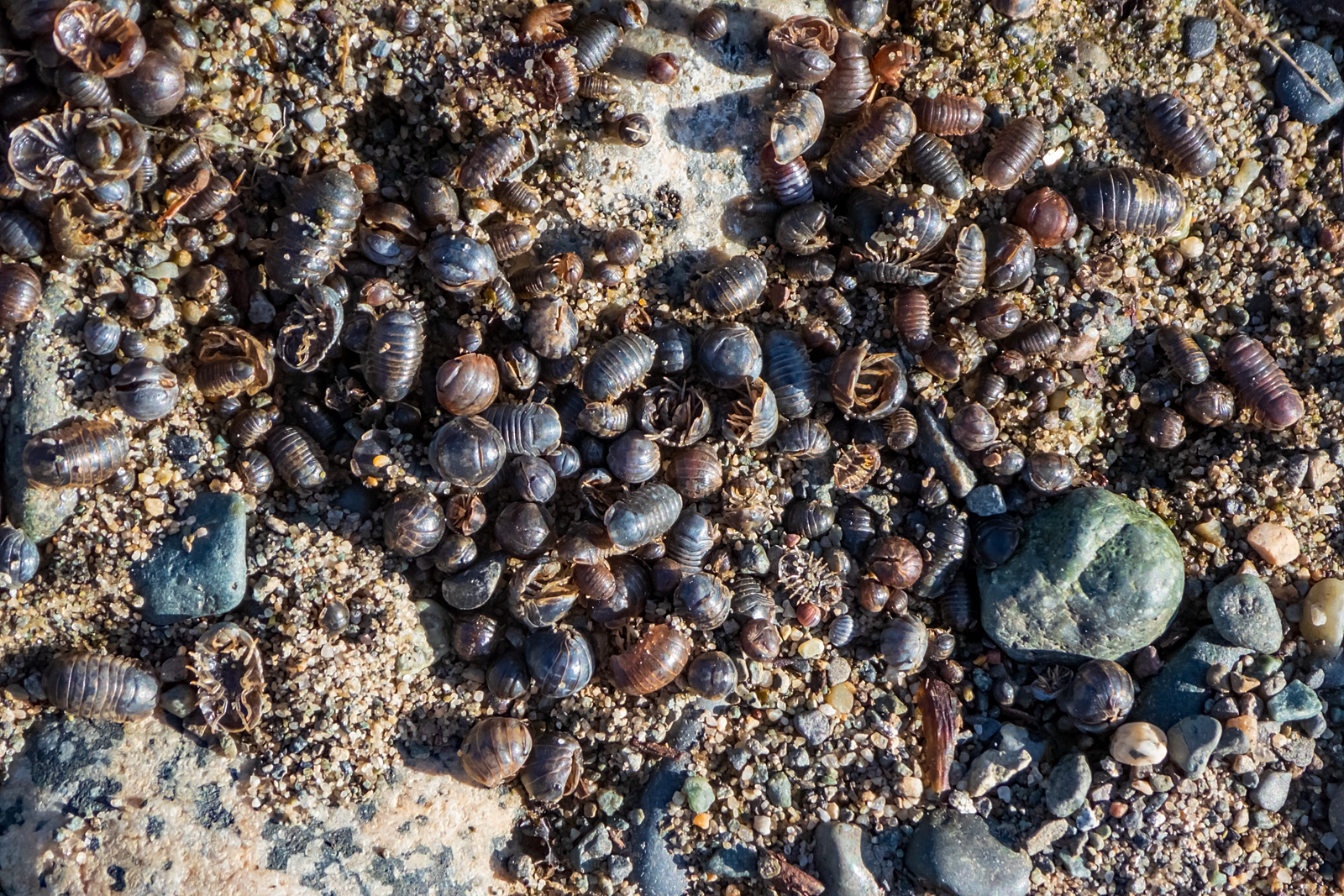
Stubby isopods, Gnorimosphaeroma oregonensis. The name is bigger than a half dozen of these.
Stubby isopods roll into a ball when they're disturbed, like the pill bugs in my garden.* The babies, rolled up, may be only 1 mm. in diameter; little, round grains of sand. A big male, stretched out, can reach up to 1 cm. The ones in this group are smaller; all females.
It's spring; party time, time to find mates and start the next generation. For the stubby isopods, that means sex changes and harems. The baby isopod hatches as a female. She becomes a member of a harem "owned" by one male, produces one brood, then begins a series of molts which transforms her into a male, ready to find his own harem of immature, smaller females. If the harem's male is removed, or dies, the dominant female in the group becomes a male to take his place.
Zooming in.
Mature stubbies have 7 pairs of legs; the babies only have 6. That's all I can count on any of these. They have compound eyes, visible on a few in this photo.
Years ago, I made a video of a baby, 1 mm. long:
I carefully replaced the rock in the same position. And the tide was coming in.
*New word: conglobate: to roll up into a ball.
~~~~~~~~~~~~~
Donde el rio Campbell llega al oceano, se extiende, formando lagunas y pantanos, un sitio ideal para aves acuáticas y, donde llega la marea, para focas. En el extremo la lengua de tierra Tyee encierra todo, dejando solo una salida angosta hacia el mar. Las costas de esta lengua son de piedra limpia, sin algas marinas ni restos de conchas. Aquí los corrientes son fuertes; justo al norte el agua sale del estrecho Seymour a unos 15 millas náuticas por hora, y aquí en la boca del rio, se duplica. El agua es salada, luego dulce, luego salada ... según sube y baja la marea. Es un habitat algo difícil para las criaturitas marinas. Aquí no he visto nunca un cangrejo; no hay caracoles marinos, no hay bálanos.
Ayer la marea estaba la más baja que he visto en este sitio. En el lado interior de la lengua de tierra, el lado que da al rio, unas piedras grandes, colocadas para sostener un puesto de observación de aves, llevaban bálanos y algas verdes. Bajé al borde del agua para mirarlas. Y allí levanté un pedazo viejo de cemento.
Las criaturas que se encontraban abajo de ese cemento se parecían a los caracolitos miniaturos que cubren las rocas en otras playas isleñas. Pero éstos bailaban.
Los isóopodos cortos se hacen una bolita cuando se sienten en peligro, al igual que las cochinillas en mi jardín. Los bebitos, hechos bola, pueden medir solamente 1 mm de diámetro, mientras que un macho grande puede extenderse hasta 1 cm. Los isópodos en este grupo son más chicos; todas son hembras.
Escribí, en 2011, sobre unos que encontré en la playa de White Rock:
Estamos en primavera; temporada de fiestas, dias para buscar pareja y empezar la nueva generación. Para los isópodos cortos, eso incluye harenes y cambios de sexo. El isópodo infantil nace como hembra. Forma parte de un harén controlado por un macho, produce una cría, y luego empieza una serie de mudas que la transforma en macho, lista para buscar su propio harén de hembras. Si se pierde, o si se muere el macho de un harén, la hembra más fuerte se transforma en macho para desarrollar su función.
Foto: viendo más de cerca.
Los isópodos adultos tienen 7 pares de patas; los juveniles solo tienen 6. En esta foto solamente veo 6 animales con 6 pares. Tienen ojos compuestso, visibles en algunos en la foto.
Video: hace años hice este video de un isópodo que medía alrededor de 1 mm.
Después de sacar unas fotos, volví el pedazo de cemento a su sitio cuidadosamente. Y venía subiendo la marea. Todo estaba bien en su mundito.
I was standing in the snowy forest, nose to a tree trunk, when a woman came over the hill. She called out to me, "Where's the trail?" Without turning away from my bit of old bark, I pointed; over there, to my right, her left. She nodded, then backtracked before turning towards the trail, giving me a wide berth; there are weird people in this forest, don't get too close.
I never get tired of looking at lichen. Not weird at all. Here's what I was looking at:
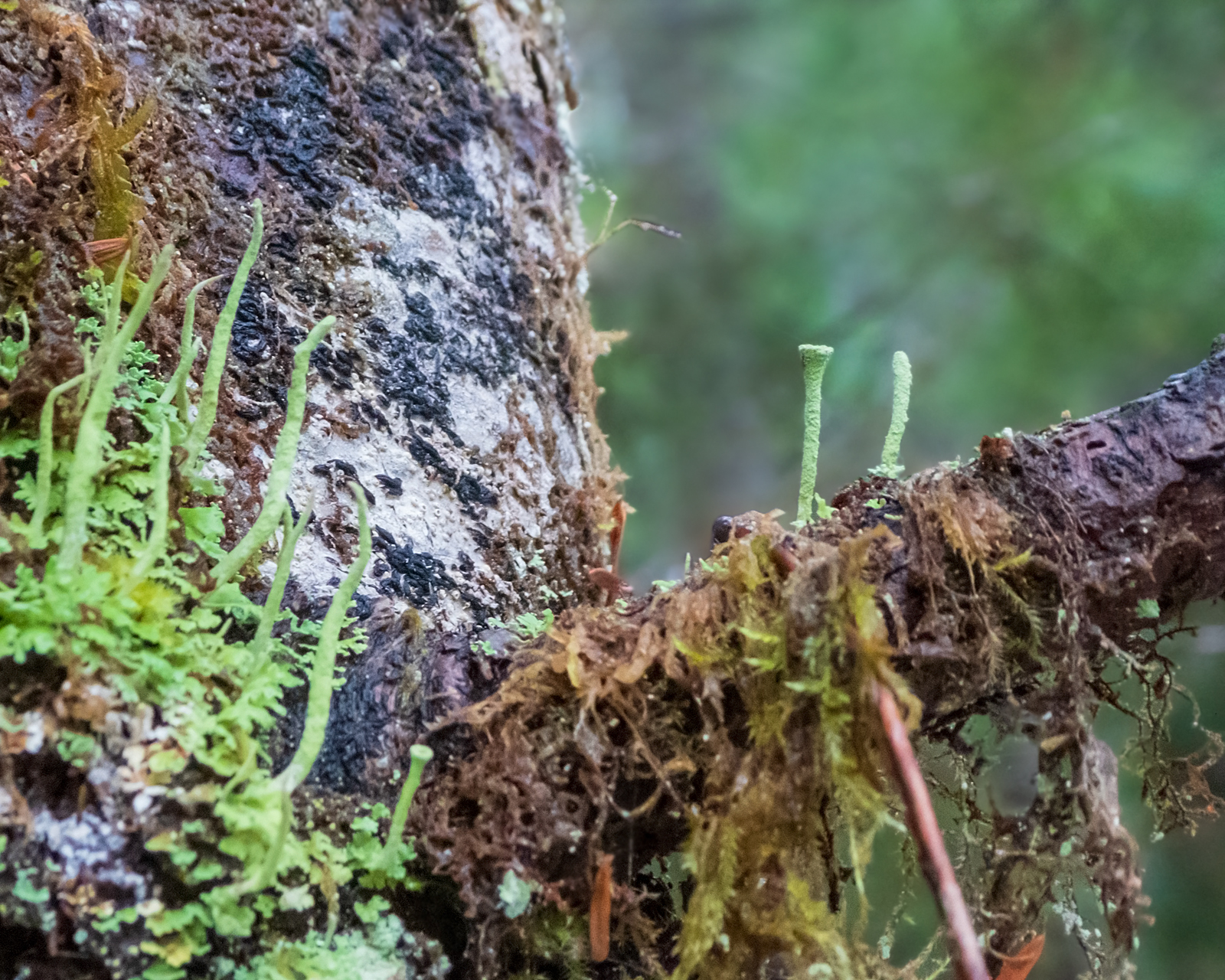
Cladonia, standing tall. There are also some tiny white barnacle lichens. Zoom in.
~~~~~~~~~~~~~~
Yo estaba parada en medio del bosque, mirando muy de cerca, a unos escasos centímetros, el tronco de un árbol, cuando una mujer apareció subiendo la cresta del cerrito atrás de mi árbol. —¿Dónde queda el sendero? — me gritó; la nieve lo había escondido y estábamos las dos en nieve sin huellas. Apunté, sin alejarme del tronco; allá a mi derecho, a su izquierda. Inclinó la cabeza, y luego volvió sobre sus huellas una poca distancia antes de dar vuelta hacia el sendero; en estos bosques hay gente extraña; hay que evitar contacto.
Yo nunca me canso de observar los líquenes. No hay nada extraño en eso.
Esto es lo que miraba, allí en ese tronco:
Liquen, del género Cladina, probablemente liquen de los renos, Cladina portentosa.
Estos son "copa de duende", Cladonia sp. Se ven las pequeñas escamas, que parecen hojas, y los cuerpos fructíferos, como copas sobre un pedestal.
Cladonia sp. Además hay unos líquenes muy pequeñitos, formandos botoncitos redondos, blancos. Hay que mirar de cerca.
In that halfway time between winter and spring, when it doesn't know whether to rain or snow, when clouds come and go, giving glimpses of blue sky and sunshine that never last. At Eve River (Parallel 50.3°N.) the snow was ankle deep, crusty on top, melting into the mud underneath. New snow dusted the hilltops; on the lower slopes, the trees had shed their load, standing with only their feet covered by the white blanket.
Up top, the trees looked like groups of walkers. On their way somewhere; to a "happening" (old word from the 60s) on the far side of the hill?
No-name hill, 1200 m.
~~~~~~~~~~~~~
Era esa temporada "a medias", cuando el dia no se decide si va a llover o a nevar, cuando las nubes van y vienen, dejando aparecer por momentos el cielo azul. Por momentos, nada más. En el rio Eve, al Paralelo 50.3°Norte, la nieve llegaba a mis tobillos; congelada y sólida en la superficie, derritiéndose, mezclándose con el lodo debajo. En los cerros, había nieve nueva, pero en las laderas ya no se veía en los árboles; solo les cubría los pies con su cobija blanca.
Allá arriba, los árboles parecían grupos de caminantes. ¿A dónde iban? ¿Hubo algún evento al otro lado de la cumbre?
Foto: desde el rio, mirando un cerro sin nombre, 1.200 m. de altura.
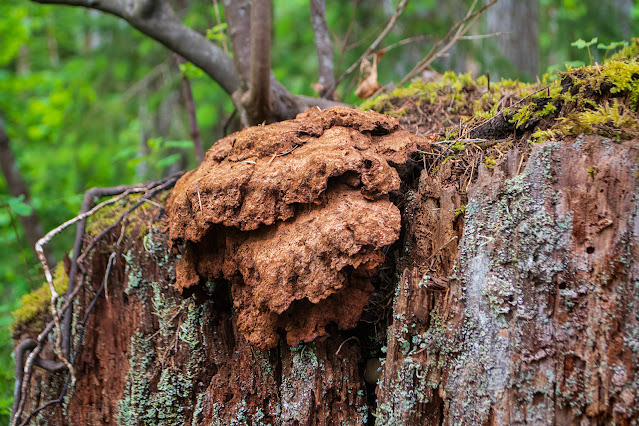
Every now and then I come across these huge, messy, broken mushrooms. They're dark brown, sometimes almost black, almost shapeless, looking like stacked cow pies. And they hide in the darkest corners of the forest, where they blend in with crumbly, rotten wood, or the duff at the roots of old trees.
We came across a couple on top of a stump where trees have been felled, allowing sunlight to penetrate. And these still have kept their shape.
Old Dyers' polypore
Second stack.
And they are intact enough to show the bands of darker colour near the edges.
I've posted photos of a typical messy one, a couple of years ago:
Stacked cow pies.
I gave up trying to identify this one. Another one I found later, with yellow bands and all, I just called "shelf fungi".
Taken with flash. Without, I couldn't see the yellow.
I keep looking for unbroken examples and never seem to find any. But actually, I have, and didn't realize it; when I finally identified the latest ones as Dyer's polypores, Google came up with hundreds of photos. Except that mostly, this is not what they look like. Young, they're pale brown, with yellow or white edges and bands. I've probably seen them many times, thinking they were possibly turkey tails. Large turkey tails; Dyers' polypores grow up to 30 cm. across.
These mushrooms are durable; the big, dark ones I've been finding are last year's fruiting bodies.
When the mushroom first emerges, the entire surface is covered in velvety yellow tissue that stains brown immediately when touched. This is the mushroom’s actively growing surface. As a testament to this fact, the stains on the tissue don’t last long; within an hour or two bruised areas become bright yellow again as new growth covers up the injury (amazingly, this can happen even after a mushroom has been picked). (FungusFactFriday)
I'll try that on the next "yellowish, velvety blob" I find.
~~~~~~~~~~~~~~~
De vez en cuando encuentro unos hongos muy grandes, medio desbaratados, de color café oscuro hasta casi negro. A veces es difícil identificarlos como hongos; más bien parecen madera podrida. Y se esconden en los sitios más oscuros del bosque.
Encontramos dos encima de un tocón cerca de donde habían caído unos de los árboles, dejando entrar unos rayos de luz. Y éstos todavía se mantienen casi enteros.
Fotos:
1, 2. Phaeolus schweinitzii, el poliporo de los teñidores. Hasta preservan las bandas de color.
3. Hace dos años, subí esta foto de uno más típico. No pude identificarlo.
4. Luego encontré éste, y con el flash se veían las bandas amarillas. Hongo repisa, dije, sin saber la especie.
Siempre estoy buscando ejemplares enteros, sin encontrarlos. O así pensaba. Resulta que los he visto muchas veces, creyendo que eran "colas de pavo". Una vez que identifiqué estos últimos como
Phaeolus schweinitzii, Google me dió cientos de fotos. Lo que pasa es que normalmente no se parecen a estas masas oscuras. Nuevos, son hongos de un color café claro o hasta crema, con bordes y bandas blancas y amarillas.
5. Un poliporo de los teñidores joven; esta foto la encontré en iNaturalist, y es uno de docenas registrados muy cerca de aquí.
6. "Los cuerpos fructíferos nuevos son apenas unas masas amarillentas, aterciopeladas." (FFF) Esta foto fue tomada por Michael Kuo, (MushroomExpert.com)
Los hongos no desaparecen al final de la temporada; los que están completamente cafés son los del año pasado.
Al principio, cuando el hongo apenas brota, toda la superficie está cubierta de terciopelo amarillo, el cual se vuelve café de inmediato al tocarlo. Esta es la superficie que está en crecimiento activo, lo que se puede comprobar viendo que las manchas en el tejido no duran; dentro de una o dos horas las areas entintadas vuelven a recuperar su color amarillo brillante, con tejido nuevo que cubre la parte dañada. (Sorprendentemente, esto puede ocurrir aun cuando el hongo ha sido cortado.) (FungusFactFriday)
Voy a hacer la prueba en el próximo "masa amarillenta, aterciopelada" que encuentro.
A sunny afternoon, almost spring. The lawn is green, the flower beds and veggie garden still bare. Seedling pots laid out, with seed packets promising summer goodies. Under the shrubbery, scuffling through last year's leaves, pecking at loose soil, gathering seeds tossed by the homeowner, the lbbs (little brown birds) are celebrating. Bouncing, hopping, scratching, chattering. They take turns at the birdbath. Some call from the trees overhead. Hummingbirds zip here and there, perch momentarily on the tips of bare branches, zip away again.
We sit on the far side, under the deck. When we stand, the birds melt into the shrubbery, waiting silently until we sit down again.
The camera sees better than my old eyes do. They're all lbbs until I see the photos on the computer screen. Then they become white-crowned, gold-crowned, fox sparrows, juncos. Then the colours show up; green, red, gold.
House finch?
Glittery green Anna's hummingbird female.
It almost looks like she's standing on air.
Fox sparrow and junco.
This one has an orange head and throat.
Three lbbs. Fox sparrow, junco, house sparrow?
The fox sparrow's "breast is heavily streaked with inverted 'V's; ... and the lower mandible is yellowish."
Golden-crowned sparrow.
~~~~~~~~~~~~~~~
Pájaros en el jardín ...
Es una tarde asoleada, a principios de la primavera. El césped está verde, los jardines — flores y verduras — siguen desnudos. Macetitas ya sembradas, con sus paquetes respectivos anunciando las delicias prometidas para el verano. Bajo los arbustos, revolviendo las hojas muertas del año pasado, picando la tierra suelta, juntando las semillas ofrecidas por el dueño de la casa, los pajaritos (LBBs, los llamamos en inglés; pajaritos cafés) celebran el dia. Saltan, brincan, rebotan, parloteando constantemente. Toman su turno en el baño o llaman desde lo alto de un árbol. Los colibríes van y vienen, se paran por un momento en el mero punto de una rama, vuelven al aire y desaparecen.
Nosotros nos sentamos debajo de la terraza, al lado opuesto del césped. Cuando nos paramos, los pájaros se esconden entre los arbustos, y se mantienen en silencio hasta que nos sentamos de vuelta.
La cámara ve mejor que mis ojos viejos. Todos los pájaros son LBBs hasta que los miro en la pantalla de mi computadora; entonces resultan ser gorriones de cabeza blanca, de cabeza dorada, zorruno, o juncos. Entonces aparecen los colores: rojo, verde, amarillo ...
Fotos:
Carpodaco doméstico, creo.
Colibrí Anna, hembra
Parece estar parada en el aire.
Gorrión zorruno y junco.
Este tiene la cabeza anaranjada.
Tres LBBs. El gorrión zorruno (Passerella iliaca) "tiene el pecho marcado con formas de V invertidas ... y el pico inferior es amarillo."
Just a puddle beside the trail. Down at human level, all was dim and brown, mud and dead leaves, lichen-coated but otherwise bare alder trunks, more mud ... I had to keep my eyes on the ground, watching my step; it could be slippery underfoot or the mud could suddenly be ankle-deep. And then, a glimpse of blue sky and sunshine far above. Somehow, it made the air feel warmer.
~~~~~~~~~~~~~
Bajo mis pies, en el lodo, brilla el sol.
En el camino, al nivel de mis ojos, todo era penumbra, colores oscuros; lodo y hojas muertas, troncos cubiertos de líquenes, más lodo ... Tenía que mantener la vista en el suelo, mirando donde ponía el pie, pues el sendero bien podría estar resbaloso, o el lodo podría de repente llegar a mis tobillos. Y luego, un charco, con agua, ofreciendo un reflejo del cielo azul y la luz del sol allá arriba. De alguna manera, hasta hizo que el ambiente se sintiera menos helado.
Tomorrow, I said. Ten days ago. Sorry about that. I've been feeling my age, shut in watching the rain through my windows, unable to manage a post. Better now, I think. And the sun came out yesterday, too.
I met this raven and its mate at the rest area beside Roberts Lake; I've seen the two there before several times, always in the same tree overlooking the picnic tables. I had a can of cocktail weiners in the car, emergency rations in case of car trouble; I shared it with the ravens. (They got most of them; I ate three.) When there were none left, this raven gave me a disapproving glare, as if I had been holding out on them.
"Is that all? Stingy!"
~~~~~~~~~~~~~~
Hace diez dias, otra vez, sin dar señales de vida. Lo siento; a veces los años pesan. He estado encerrada, viendo llover fuera de mis ventanas. Pero voy mejorando, creo, y ayer salió el sol.
Encontré un par de cuervos grandes (Corvus corax) en la zona de descanso al lado del lago Roberts. He visto esta misma pareja allí varias veces, esperando siempre en el mismo árbol cerca de las mesas de picnic. Tenía una lata de salchicas de cóctel en el coche, parte de mis raciones de emergencia, para cuando tenga algún problema en el camino, y las compartí con los cuervos. (Yo solo me comí tres; los cuervos tuvieron todas las demás.) Cuando ya no había más en oferta, este cuervo me fijó con un ojo acusador, como si yo les estuviera estafando.
I've been unable to post for over a week. Now where was I? Oh, yes; looking at mushrooms and lichens. And some rocks.
These are the last of the small finds on that hillside of mossy rock, sorted by age; fresh and new, old, ancient.
A very tiny mushroom, with moss, old Douglas-fir needles, and a bit of ice.
Leaf lichen and dry twig, both bleached almost white.
Lichen, by the time we notice it, is always old, having grown so slowly, a few millimetres a year.
Ancient, coming to us from the time of bouncing mountains: green veins in the rock, squeezed out like when I fix a broken pot and put on too much of the glue.
Pale pistachio green rock ooze. They tell me it's epidote.
Another vein, and some sprinkles.
And tomorrow, if all goes well, I can move on to the Deer Falls side hills.
~~~~~~~~~~~~~~~
Hace más de una semana que no he podido hacer un post. Y ahora, ¿dónde estaba? Ah, sí; mirando hongos y líquenes. Y unas rocas.
Estas son las últimas de las fotos que saqué en esas rocas envueltas en musgo. Las he organizado según la edad; algo fresco, algo viejo, y lo viejísimo.
Un hongo muy pequeño, con musgos, hojas de abeto de Douglas, y cristales de hielo.
Una rama rota, muy seca, con sus líquenes foliosos, todo blanqueado hasta volverse casi blanco. Los líquenes, crecidos hasta llamarnos la atención, siempre son viejos, ya que crecen tan despacio, al son de uno milímetros por año.
Y viejísimo, ya que nos llega desde la juventud de las montañas; venas de roca verde, exprimida de entre la piedra mayor mientras se enfriaba.
Otra vena, y gotitas.
Siguiente: otro cerro, éste cerca de las cataratas Deer.
Nests full of eggs. Eggs that look like dried beans. And some like little buttons. Nests a half-centimetre across. Eggs that will give rise to no birdies.
Bird's nest fungi, of course. And the "eggs" are spore cases.
Nest found near Echo Lake.
These are growing on a dry twig, very dead, broken from its dead tree as it came crashing down onto an exposed hillside, all mossy rock. The nest is white and hairy on the outside. (Hard to see; the sun was too bright for my pocket camera.) And the spore cases are clustered inside, brown and slightly kidney-shaped.
Vocabulary: there are always so many words to learn! The nest itself is called a peridium (plural, peridia). And the "eggs" are peridioles. All these belong to the family Nidulariaceae (So many vowels!) from the Latin "nidula" which just means "little nest".
There can be as many as 30 million spores in a single peridiole (Hassett et al. 2015), so an individual bird's nest fungus fruiting body could have more than a billion spores! (AskIFAS, U. of Florida)
Good thing most of them don't find a home, or we'd be buried under mountains of tiny bird's nests!
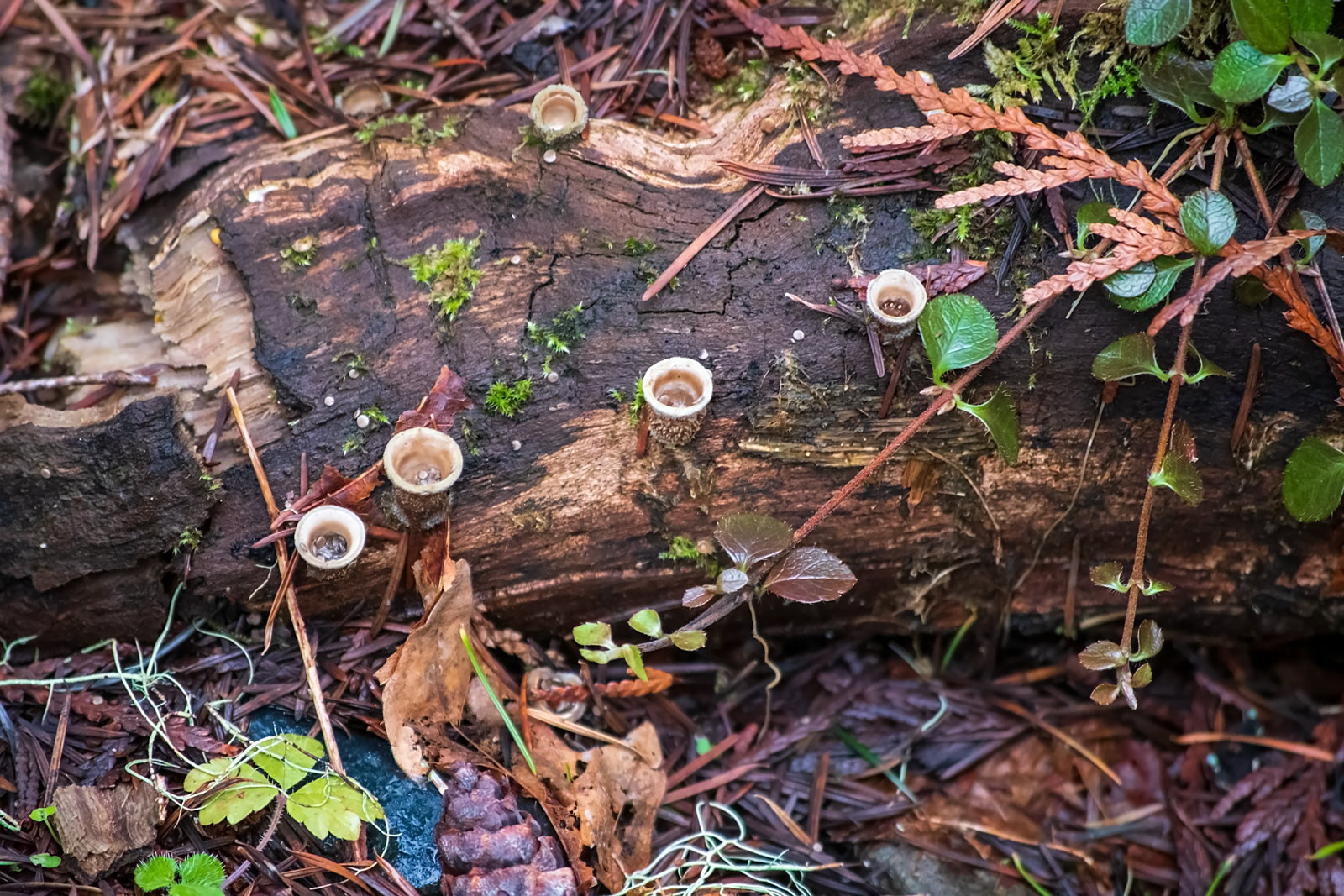
These next ones are growing on a broken branch in shady woods.
Nest found near Elk Falls.
Here, the peridioles are plump round disks, off-white to brown. Quite a few have already left the nest; you can see them on the log.
I think, going by the brownish outside of the nest, and the colour of the peridioles, that these may be Nidula candida, the common gel bird's nest; it grows on rotting wood or on soil. The first one above may be Nidula niveotomentosa, the white-barrel bird's nest, which grows among moss and bracken ferns.
~~~~~~~~~~~~~
Nidos llenos de huevos. Huevos que se parecen a frijoles. O a botoncitos. Nidos que miden un escaso medio centímetro. Huevos que no van a producir pajaritos.
Son los hongos "nido de pájaro". Y los "huevos" son saquitos de esporas.
Fotos:
1. Hongo nido cerca del lago Echo. Estos crecen en una rama seca, muerta, separada de su árbol muerto cuando éste cayó encima de una roca cubierta de musgos. El "nido" es blanco, y su exterior es peludo. (Algo difícil de ver en esta foto; el sol estaba demasiado fuerte para mi camarita de bolsillo.) Los sacos de esporas en el interior son color café, con una forma parecido a la de los frijoles secos.
Vocabulario: ¡Siempre hay tantas nuevas palabras! Los nidos se llaman "peridia" (sing. peridium). Y los "huevos" son peridiolos. Estos hongos pertenecen a la familia Nidulariaceae. (¡Tantos vocales!) La palabra viene del latín; nidula, o sea niditos.
Puede haber hasta 30 millones de esporas en un solo peridiolo (Hassett et al, 2015) por consiguiente un solo ejemplar del hongo nido de pájaro podría contener más de un millón de millones. (AskIFAS, U. de Florida)
Por suerte, la mayoría no encuentran sitio donde establecerse, o si no, estaríamos sepultados bajo montañas enteras de honguitos!
2. Estos están creciendo sobre una rama podrida en la sombra de un bosque denso. Aquí, los periodolios son disquitos gorditos y redondos, de color blanquisco hasta marrón. Muchos ya han saltado del "nido"; se ven esparcidos alrededor.
Creo, debido al color café del exterior y el color de los periodolos, que estos son de la especie Nidula candida, que crece en madera podrida o en el suelo. El primero, creo que pertenece a la especie Nidula niveotomentosa; éste crece entre musgos y helechos.